Tricone Bits vs PDC Bits — When to Use Each
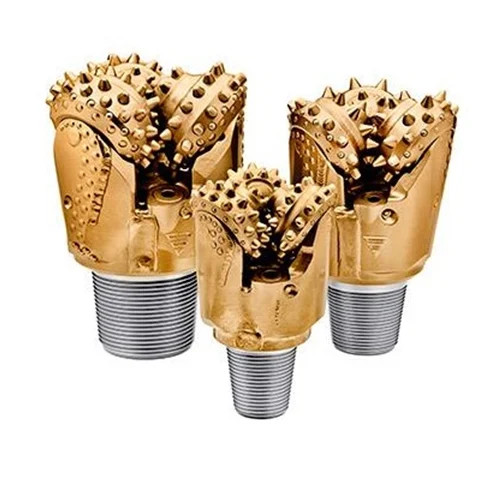
If you are drilling in sedimentary formations — oil and gas exploration, water wells in alluvial basins, or geotechnical investigation in softer rock — you will eventually face this choice: tricone or PDC?
Both are rotary drill bits. Both are used across Africa, the Middle East, and globally. But they work on entirely different cutting principles, have different cost profiles, and suit very different conditions.
This guide explains both clearly, compares them head to head, and tells you when each is the right tool.
How Tricone Bits Work
A tricone bit (also called a roller cone bit or tri-cone) has three rotating cone-shaped cutters mounted on bearings. As the drill string rotates, the cones roll across the rock face, crushing and chipping the formation.
Two main variants:
- Milled Tooth (MT): Steel teeth machined into the cone surface. Used in soft, unconsolidated formations — clay, soft sandstone, shale. Fast penetration, lower cost, but teeth wear quickly in harder rock.
- Tungsten Carbide Insert (TCI): Carbide inserts pressed into the cones. More durable. Used in medium to hard formations — limestone, dolomite, harder sandstone.
Key characteristics: <ul> <li>Cutting action is crushing and chipping — effective across a wide range of formation hardness</li> <li>Works at relatively low WOB (weight on bit) and RPM</li> <li>Requires regular bearing maintenance — bearings are the most common failure point</li> <li>Available in virtually every bit size from 3.5" to 36"+</li> <li>IADC classification codes (from 1 to 8) define hardness suitability: 1–2 for soft formations, 6–8 for hard</li> </ul>
How PDC Bits Work
A PDC bit (Polycrystalline Diamond Compact) uses fixed synthetic diamond cutters bonded to a steel or matrix body. There are no moving parts. As the bit rotates, the cutters shear the rock rather than crush it.
Key characteristics: <ul> <li>Shearing action is highly efficient in consistent, non-abrasive formations</li> <li>No moving parts — no bearings to fail</li> <li>Very high penetration rates in the right formation</li> <li>More sensitive to formation changes — abrupt hardness variations can damage cutters</li> <li>Higher upfront cost than tricone, but can drill significantly more metres per run</li> <li>Common cutter configurations: 4-blade, 5-blade, 6-blade; cutter size from 8mm to 19mm</li> </ul>
PDC is the dominant bit type in oil and gas drilling globally because most oil-bearing formations (shale, soft limestone, sandstone) are exactly the conditions where PDC excels.
Head-to-Head Comparison
| Factor | Tricone | PDC |
|---|---|---|
| Cutting mechanism | Crushing and chipping | Shearing |
| Moving parts | Yes — three bearing assemblies | No |
| Best formations | Soft to hard (broad range) | Soft to medium (consistent rock) |
| Hard abrasive rock | TCI variant handles it | Poor — cutters chip and wear fast |
| Interbedded formations | Handles variation well | Can be damaged by sudden hardness changes |
| Penetration rate (ideal conditions) | Moderate | High to very high |
| Bit life | Moderate — bearings limit life | High — no moving parts to fail |
| Upfront cost | Lower | Higher |
| Cost per metre (correct formation) | Moderate | Lower (more metres per bit) |
| Directional drilling compatibility | Good | Excellent — preferred for directional |
| Available sizes | 3.5" to 36"+ | 3.75" to 26"+ |
When to Choose a Tricone Bit
1. You Are Drilling Through Variable or Unknown Formations
Tricone bits are the more forgiving choice when you do not have a reliable formation log and expect significant variation in hardness. The crushing mechanism handles transitions between soft shale and harder limestone without the cutter damage risk that PDC faces.
This is common in West African sedimentary basins (Niger Delta, Volta Basin, Senegal Basin) where multiple formation layers with different hardness appear at unpredictable depths.
2. The Formation is Hard or Abrasive
TCI tricone bits remain the standard for medium-hard to hard formations — carbonates, dolomite, harder sandstone. When rock strength exceeds the threshold where PDC cutters chip, a TCI tricone is the practical choice.
3. You Need a Specific Large Diameter
For large-diameter holes (12"+), tricone bits are more widely available and often better supported with local rental or supply options across Africa. PDC in very large diameters is available but less common outside of oil and gas specialist markets.
4. Budget Is the Primary Constraint
Tricone bits carry lower upfront cost than comparable PDC bits. In markets where capital outlay is tightly managed and per-run economics matter more than total-well cost, tricone is the practical default.
When to Choose a PDC Bit
1. You Are Drilling Consistently Soft to Medium Formation
PDC excels where the formation is predictable — shale, soft limestone, unconsolidated sandstone, marl. If your well log or regional data shows a consistent lithology column from surface to target depth, PDC will almost always drill faster and cost less per metre than tricone.
This applies to many North African and Middle Eastern formations: Egyptian Western Desert shale sequences, Saudi Arabian soft limestone, UAE coastal sedimentary layers.
2. You Are Drilling a Deep Well and Bit Trips Are Expensive
Every time you pull a bit, you lose time. On a 2,000m oil exploration well, a bit trip can cost 8–12 hours of rig time. PDC bits routinely drill 3–5× more metres per run than a tricone in the right formation, dramatically reducing trip frequency.
3. You Are Doing Directional Drilling
Directional and horizontal drilling (common in oil and gas, increasingly in geothermal) requires a bit that responds predictably to toolface orientation. PDC bits are preferred because the shearing action is more controllable and consistent than the impact-and-crush mechanism of tricone.
4. You Want Maximum Penetration Rate
Where formation conditions are right, PDC achieves substantially higher ROP (rate of penetration). In soft shale, a good PDC bit can drill 3–5× faster than a tricone. Where rig time is expensive, this speed advantage quickly offsets the higher bit cost.
Where DTH Fits
It is worth being clear: both tricone and PDC are rotary drill bits. They are driven by drill string rotation and rely on WOB (weight on bit) for penetration.
DTH (Down-the-Hole) drilling is a different method entirely — percussive, not rotary — and is the standard approach for hard crystalline basement rock (granite, gneiss, quartzite) at depth.
If you are drilling in Nigeria's basement complex, Kenya's Rift Valley trachyte, or any hard formation below 50 metres, DTH will outperform both tricone and PDC on penetration rate, bit life, and cost per metre.
| Bit / Method | Best Application |
|---|---|
| Milled Tooth Tricone | Soft sedimentary, shallow, variable formations |
| TCI Tricone | Medium to hard sedimentary, variable hardness |
| PDC | Consistent soft to medium sedimentary, deep wells, directional |
| DTH Button Bit | Hard basement rock, any depth over 50m |
Most drilling contractors working across Africa need more than one of these in their toolkit. The formation, depth, and project type determine the right tool — not brand preference or habit.
A Practical Decision Framework
Before ordering bits, answer these four questions:
- What is the dominant rock type? Basement granite → DTH. Soft shale/sandstone → PDC. Mixed/variable or medium-hard carbonate → tricone.
- How consistent is the formation? If lithology varies significantly, tricone handles transitions better than PDC.
- What is the target depth? Shallow (under 50m) in hard rock → Top Hammer or TCI tricone. Deep in hard rock → DTH. Deep in soft/medium sedimentary → PDC.
- What is the rig type? DTH requires a high-pressure air compressor (150–900 CFM). Tricone and PDC require a rotary rig with WOB control and mud/air circulation. If you only have one rig type, work within its capability.
Not sure which applies to your project? Send us your formation data and we will give you a recommendation.
Summary
- Tricone bits are versatile, forgiving of formation variation, and the right choice for variable sedimentary sequences, medium-hard carbonates, and budget-sensitive operations.
- PDC bits deliver higher penetration rates and lower cost per metre in consistent soft-to-medium formations, and are the preferred choice for directional drilling and deep oil and gas wells.
- DTH remains the correct method for hard crystalline basement rock at any significant depth — where tricone and PDC both underperform.
At Global Edge, we stock DTH hammers and button bits for hard rock water well drilling across Africa and the Middle East. For tricone and PDC requirements, our technical team can advise on selection and connect you with the right supply channel for your application.
→ Browse DTH Drilling Products → DTH vs Top Hammer — Full Comparison → Request a Quote or Technical Advice → Drilling Equipment for Nigeria → Drilling Equipment for Kenya
Zero rig downtime starts with parts already on the shelf.
Not sure of your exact hammer or bit spec? Send a photo on WhatsApp — we verify shank, thread and diameter against Abu Dhabi stock and send part numbers + landed price to your port within 4 working hours. Free, no obligation. Backed by a 90-day replacement guarantee and 48–72h air dispatch.